Cáncer de Pulmón
Lung cancer is the type of cancer with the highest death rate worldwide; it is considered a silent disease because it is a painless organ. Thousands of studies have corroborated that the main risk factor for lung cancer is smoking.
The key lies in prevention and quality of care.
Early detection is essential to increase the chances of cure; although lung cancer has no symptoms during its early stages, it can be detected early by performing a CT scan and other tests.

Treatment methods depend on the type of lung cancer and its current stage.

Lung cancer was the leading cause of death in men with the disease during the last two years.
One pathology, different stages
Determining the stage of the cancer (0, I, II, II, III, IV) is essential to choose the appropriate treatment for each patient.

General Welfare
We make our patients' experience easier by offering everything they need to beat cancer in one place: Hematology, Radiation Oncology, Algiology, Interventional Oncology and more.

The Specialist
We bring together the best experts in oncology for your recovery. Our medical team's goal is to stop cancer and increase your chances of survival.
What is lung cancer?
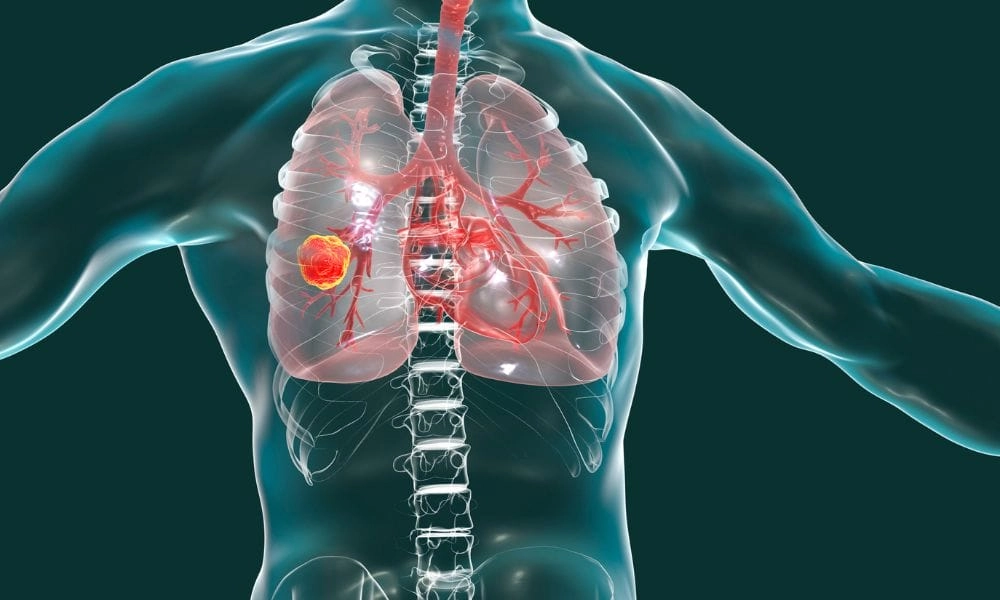
It is a type of cancer that originates in the lung lining; it usually appears as tumors in the epithelium of the airways, including the bronchi, bronchioles and alveoli.
The lungs are a pair of spongy tissue organs located in the thorax; their function is to provide oxygen to the blood when inhaling and to release carbon dioxide when exhaling.
How many stages does lung cancer have?
The treatment given to a given patient's lung cancer will depend directly on the stage of the disease. The stages of the disease are as follows:
Stadium 0:
The healthy lung begins to show signs of dysplasia.
Stage I:
The development of the tumor has not exceeded 3 cm in diameter; neither has it spread to other organs or lymph nodes.
Stage II:
The tumor has spread to nearby lymph nodes.
Stage III:
The cancer has spread to more distant lymph nodes; it may have reached other surrounding tissues (esophagus, heart, etc.).
Stage IV:
Cancer has metastasized to other vital organs of the human body, for example: liver, brain, adrenal glands, bones, among others.
Types of lung cancer
Lung cancer is mainly divided into two types:
Small cell lung cancer.
Non-small cell lung cancer (the most common).
Both types have different characteristics, causing the treatment to be totally different in each case.
Contact us at
. Schedule an appointment
Request a consultation
Symptoms of lung cancer
Some of the signs that warn of the presence of lung cancer are:
Cough: In advanced stages the urge to cough appears constantly; the patient may also feel the cough intensify as the days go by and notice that it leaves traces of blood.
Chest pain: The patient may experience chest pain when inhaling and exhaling deeply, coughing or laughing.
Respiratory distress: This is shown by tiredness and weakness to breathe, and recurrent infections such as bronchitis or pneumonia.
Frequent sputum of saliva or phlegm in brown tones.
Inappetence (Loss of appetite).
Voice changes: Aphonic, rough or hoarse diction.
It should be noted that some lung cancers can trigger the appearance of syndromes such as Horner's syndrome, superior vena cava syndrome, paraneoplastic syndromes, Cushing's syndrome...
Risk Factors
The risk factors listed below significantly increase the likelihood of developing lung cancer:
Smoking: Tobacco smoke, cigarettes and pipes are the most important risk factor for lung cancer. The disease mainly affects active smokers; however, passive smokers can also be harmed to a slightly lesser extent.
Exposure to toxic or radioactive agents: People who work, breathe or come into direct contact with substances, materials and compounds such as: radon, asbestos, uranium, arsenic and diesel combustion residues, are more likely to develop lung cancer.
Previous radiological treatments: Having received radiation doses to treat previous diseases, including breast cancer and Hodgkin's disease, increases the propensity to cancer.
Family history: The risk may be slightly increased in those whose close relatives have suffered from this disease.
Screening tests
The only test recommended for the actual diagnosis of lung cancer is the low-dose CT scan, in which a minimal amount of radiation is delivered to the chest area. This screening test is also known as low-dose CT or LDTC (Low Dose CT).
The procedure begins by placing the patient lying on the table of the tomography equipment; subsequently, this table will move towards the "gantry" where the emission of low-dose X-rays will begin to obtain defined images of the lungs. The process takes a few minutes and is completely painless.
Who can undergo a low-dose CT scan?
This screening test is advisable for those who:
They have been active smokers for more than 20 consecutive years.
They were long-time smokers, but quit within the last 15 years.
They have a higher risk due to their age (applies to adults between 50 and 80 years of age).
Lung cancer treatment
As mentioned above, the treatment of lung cancer varies according to the type of cancer the patient presents (small cell cancer or non-small cell cancer).
Treatment options for non-small cell cancer, also known as non-small cell lung cancer, include:
Surgery: Removing the tumor surface in early stages.
Radiofrequency ablation: Especially in people with small tumors located at the outer edges of the lung.
Radiotherapy: Applying doses of radiation to eliminate cancer cells. This option can be used as an initial treatment, after surgery or palliatively.
Chemotherapy: Chemotherapy treatments can be given before and after surgery; applied together with radiotherapy as part of the main treatment or administered in metastatic lung cancer.
Targeted therapy: In this therapy, specific drugs are used that are able to counteract cellular alterations.
Immunotherapy: Immunotherapy seeks to nourish and strengthen the patient's immune system, so that it can recognize and destroy abnormal cells on its own.
Palliative care: There are multiple palliative alternatives to alleviate discomfort and provide a better quality of life for the patient with advanced lung cancer.
Patients with small cell (microcytic) lung cancer experience much more accelerated growth and spread than non-small cell lung cancer; for this reason, the way it is treated is quite complex.
In these cases, chemotherapy is one of the first actions to attack the cancer in a comprehensive manner. Other treatments can also be added to chemotherapy to achieve greater efficacy, among them: radiotherapy, immunotherapy, or even all three options at the same time.
Being a fast spreading cancer, surgery is rarely considered as a treatment option. The physician may actually consider surgery feasible when small cell lung cancer has been detected in early stages.
In microcytic cancer, palliative care is still considered a good alternative to calm the symptoms and endure the difficulties inherent to the disease.

Lung cancer prevention
Lung cancer can come unexpectedly; however, there are some measures you can take in your daily life to reduce the risk of developing it.
Avoid tobacco use.
Stay away from people who smoke.
Limit any activity that may expose you to carcinogens and carcinogenic substances.
Maintain a balanced diet and include plenty of fruits and vegetables.