Leukemia
It is the most frequent type of hematologic cancer in children and adolescents; it is the first cause of death by disease in childhood. Although leukemia is a very uncommon cancer in adults, when it appears in advanced age it can have an accelerated development.
A place with specialized treatment and timely decisions
The symptomatology of leukemia is very complex and may vary according to the type of cancer that each patient develops. To obtain an accurate diagnosis, the patient must undergo specific blood counts and bone marrow biopsies to detect the type of leukemia.

Acute myeloid leukemia accounts for 33% of all cases of the disease.

The survival rate of children with leukemia is very encouraging with proper treatment.

Personalized medical approach
Treatment for children will never be the same as for an adult; we take each case individually to obtain the ideal approach that the patient deserves.

General Welfare
In your battle against leukemia you will never be alone; in our center you will find the support of oncology psychologists and nutrition specialists to make your process more emotionally balanced.

The Specialist
A vast medical team led by hematologists and clinical oncologists will help you find the best treatment alternatives to overcome the disease.
What is leukemia?
It is a hematological disease that originates when blood-producing cells suffer chromosomal mutations that alter cell division, causing them to multiply non-stop and become cancerous.
There are many different types of leukemia; some of them develop especially in children, while others appear only in older adults.
The formation of white blood cells is directly involved in the onset of leukemia, since it is precisely these cells that reproduce and divide in an organized manner to attack infections in the human body. However, people suffering from leukemia produce an uncontrollable amount of abnormal white blood cells, which, when not working properly, eventually turn into cancer.
Acute lymphocytic leukemia in adults
Acute lymphocytic leukemia (ALL) is a type of cancer that mainly affects lymphocytes (white blood cells) and bone marrow; it can extend its scope to red blood cells and platelets.
The uncontrolled production of leukemic cells in the blood leaves less room for healthy cells to perform their normal functions, making the patient more prone to infections, bleeding and anemia.
This disease worsens rapidly when not treated in time; its diagnosis includes: blood tests and bone marrow biopsies to confirm it. In some cases, acute lymphocytic leukemia can spread to other parts of the body, including: lymph nodes, central nervous system, liver, spleen, testicles, etc.
Acute myeloid leukemia
Acute myeloid leukemia (also known as non-lymphocytic leukemia) begins in the bone marrow and quickly spreads to the blood. Like lymphocytic leukemia, this disease can spread to vital organs.
Unlike other types of cancer, acute myeloid leukemia has the particularity of not forming tumors; therefore, its extension starts from the bone marrow to places such as the spleen and liver. In this specific case, the prognosis will depend on the patient's subtype of acute myeloid leukemia, age and the rest of the laboratory results.
The classification of acute myeloid leukemia is divided according to the characteristics of the developed cells and their maturity. The subtypes of AML range from M0 to M7 and are named as follows:
(M0) Acute undifferentiated myeloblastic leukemia (white blood cells).
(M1) Acute myeloblastic leukemia with minimal maturation (white blood cells).
(M2) Acute myeloblastic leukemia with maturation (white blood cells).
(M3) Acute promyelocytic leukemia (white blood cells).
(M4) Acute myelomonocytic leukemia (white blood cells).
(M4 eos) Acute myelomonocytic leukemia with eosinophilia (white blood cells).
(M5) Acute monocytic leukemia (white blood cells).
(M6) Acute erythroid leukemia (red blood cells).
(M7) Acute megakaryoblastic leukemia (Platelets).
Chronic lymphocytic leukemia
It is a cancer of the blood and bone marrow that grows in the B cells of the white blood cells; its development is slow and it usually appears in Caucasian adults over 65 years of age.
The patient with chronic lymphocytic leukemia may last for years with the disease without having experienced any symptoms; however, when it is already in an advanced stage, he/she may show signs such as: bruises scattered throughout the body, fatigue and swollen lymph nodes.
Although the chances of a complete cure of the disease are very low, people with CLL can have a long and full life with proper medical treatment.
Contact us at
. Schedule an appointment
Request a consultation

Chronic myeloid leukemia
Chronic myeloid leukemia starts directly in the bone marrow due to a spontaneous chromosomal alteration; it is slow-growing and very unusual. Older adults are the most prone to suffer from it, predominating more in men than in women.
As it has a prolonged development, the symptoms are almost imperceptible during the early stages. Later on, the disease will show symptoms such as: tiredness, bleeding, weight loss, excessive night sweats and changes in skin tone (pallor).
Leukemia in children
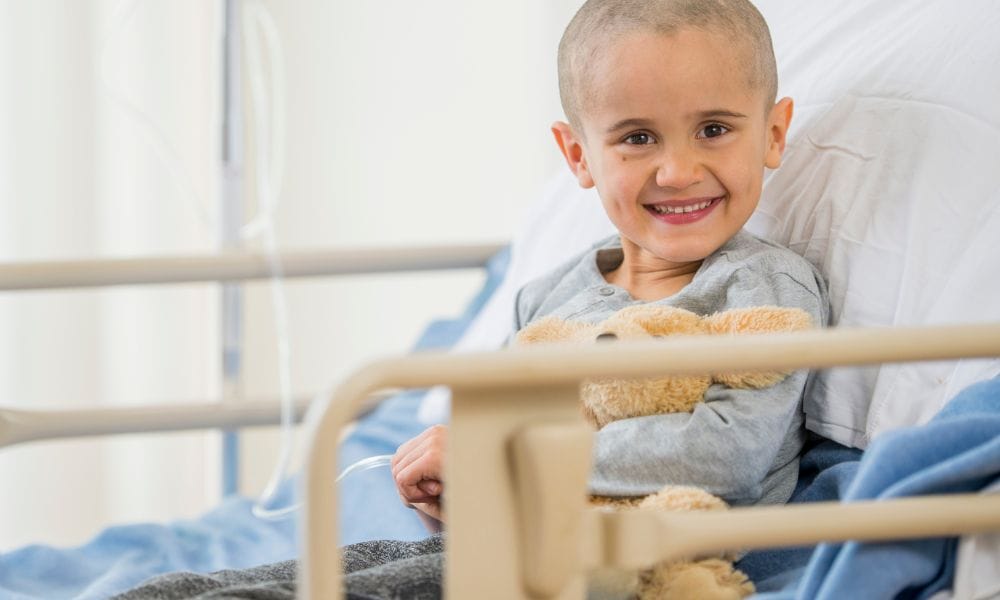
In childhood leukemia, the bone marrow has an uncontrolled production of white blood cells; these abnormal leukemic cells are not able to protect the body, much less fight infection or other diseases.
Childhood leukemia usually has a strong and unexpected onset, which is why the numbers of the disease in children are often so alarming. Acute lymphocytic leukemia and acute myeloid leukemia are the most frequent, both being fast-growing.
Symptoms of leukemia in adults
People with leukemia may have the following symptoms:
Weakness.
Fatigue.
Fever.
Weight loss for no apparent reason.
Pain in the back, bones or thoracic area.
Recurrent infections.
Lack of air.
Inflammation of the lymph nodes.
Dizziness.
Irregular or elongated menstruation (women).
Headaches.
Pallor.
Wounds that do not heal.
Red spots on the skin.
Irritated or bleeding gums.
Slow healing.
Bruises.
It should be noted that the appearance of these signs is not always the same in all cases; therefore, each leukemia patient may perceive the signs in a very different way from the rest.
Symptoms of leukemia in children
Many pediatric patients are so young that they do not know exactly how to express what they are feeling; the task of the family is to carefully observe the child's behavior in order to treat both the symptoms and the disease itself in time.
Childhood leukemia may show warning signs such as:
Constant fatigue.
Fever.
Pallor.
Night sweats.
Hematomas.
Bleeding.
Lack of appetite.
Weight loss.
Red dots under the skin (internal bleeding).
When to consult a physician?
Many types of leukemia progress stealthily, so we recommend seeing a doctor after experiencing some of the symptoms mentioned above. It is also important for people with a family history of leukemia to have preventive check-ups to rule out the disease.


Causes of leukemia
Even today, the causes of the cellular alterations that lead to leukemia are still being studied. However, risk factors that increase the manifestation of the disease have already been determined; this point will be explained below...
Risk Factors
Risk factors are considered to be all those characteristics that can increase the probability of suffering a disease, for example: leukemia.
The main risk factors for leukemia are:
Age: The most prone are children/young people up to 15 years old and adults over 65 years old.
Sex: Some types of leukemia occur more frequently in males than in females.
Smoking: Tobacco smoke is full of carcinogens, which can be absorbed by the body and spread through the bloodstream.
Exposure to chemicals, including: benzene, cigarette smoke and gasoline vapors, glues, detergents or solvents.
Blood disorders (idiopathic myelofibrosis, polycythemia vera, essential thrombocythemia, etc.).
Previous chemotherapy or radiation treatments .
Genetic birth mutations (Bloom, Shwachman-Diamond, Li-Fraumeni, Kostmann, Down syndrome, among others).
Family history (mother, father or siblings with leukemia or other cancers).