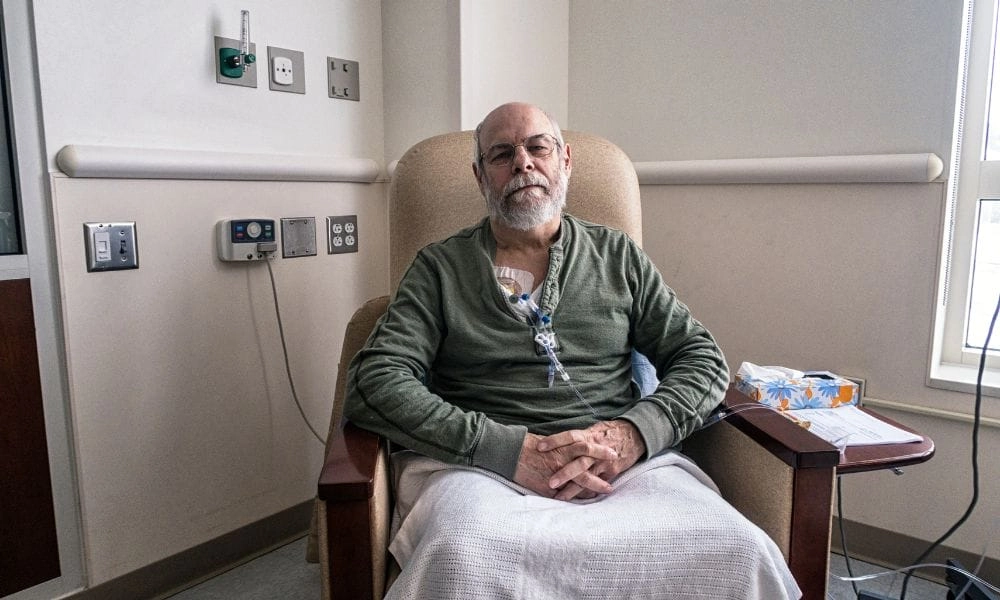
Breast Cancer in Men
Although it is rare, men can also develop breast cancer. Breast cancer is often associated with women; however, men can develop breast cancer and have a survival rate very similar to that of their female counterparts.
We are your allies in the fight against male breast cancer.
Timely diagnosis and treatment is fundamental to successfully overcome the disease. The clock of people with cancer speeds up when the patient is not treated properly; fortunately, at Panama Cancer Clinic you will find a multidisciplinary team specialized in this area that remains somewhat unexplored by others.

The incidence of male breast cancer increases in men over 60 years of age.

Approximately 15% of the cases come from a family history.

Diagnosis and Staging
The obvious symptomatology favors the diagnosis, but first, the affected patient has to be able to admit that something is not right and go to the doctor to know the definitive result.

Welfare
Being a rare disease in men, the emotional shock can be greater, therefore, in Panama Cancer Clinic we provide psychological support during each stage of this process.

The Specialist
Our oncologists of impeccable trajectory and renown are the most suitable professionals to attend atypical cases such as this one.
What is male breast cancer?
It is a very rare type of cancer that progressively forms in male breast tissue. All human beings, whether male or female, are born with a small portion of breast tissue consisting of: glands (milk-producing), fat and ducts that transport milk to the nipples.
At puberty, women go through a developmental stage in which breast tissue grows in greater proportion than in men. However, this minimal amount of breast tissue is sufficient for breast cancer to form in men.
Breast cancer self-examination in men
It is time to disprove the belief that men are immune to breast cancer. Male self-examination is just as important as female self-examination and, contrary to what many believe, taking care of their health in this way does not detract from their masculinity.
To perform a male self-examination, you should stand in front of a mirror to carefully observe the appearance of your breasts. Slowly touch the breast in a clockwise direction while visualizing any changes in the size or shape of both the breasts and nipples; this area should have no abnormalities, lumps, swelling, scaling, or skin changes.
If you notice any changes during the self-examination, we recommend that you see your doctor as soon as possible for a comprehensive evaluation.
Types of breast cancer in men
The types of breast cancer in men are the same as those that develop in women. Among the most common we can mention:
Ductal carcinoma:
This type of male breast cancer is the most common and originates in the breast ducts. Ductal carcinoma in situ is not invasive since it affects only the lining of the ducts. Infiltrating ductal carcinoma can extend to the breast tissue and spread to other nearby organs.
Lobular carcinoma:
Cancer cells begin to grow in the lobules and continue to multiply; without treatment, they can eventually affect the breast tissue and invade other organs of the body.
Contact us at
. Schedule an appointment
Request a consultation

Breast Cancer Symptoms in Men
How to detect breast cancer in men?
Signs that warn of the presence of male breast cancer can be perceived through:
A self-examination.
A medical evaluation with analysis of family history.
Ultrasound scans to observe the abnormal tissue and rule out other problems.
Biopsy to confirm the diagnosis and to know the type and extent of the cancer.
MRI to detect and have an exact location of the cancerous nucleus.
Biochemical blood studies for early detection in people at high hereditary risk.
Screening tests
Risk factors that may increase the likelihood of breast cancer in men include:
Age (men over 60 years of age).
Inherited genetic mutations, mainly of the BRCA1 and BRCA2 genes.
Excess estrogen due to the consumption of hormonal drugs.
Klinefelter's syndrome, which causes abnormal testicular growth that triggers irregular hormone production in males.
Liver diseases.
Overweight.
Other testicular diseases such as, for example: orchitis.
Prevention
How to prevent breast cancer in men?
If you are aware that some members of your family have suffered from breast or ovarian cancer, or if there is a BRCA1 or BRCA2 gene mutation, it is advisable to make at least one visit to your doctor to discuss these doubts and to know what other decisions you can make to take care of your health in the future.
Men can also ensure a good quality of life and reduce risks by maintaining a balanced diet, maintaining an adequate weight and avoiding a sedentary lifestyle.
Treatments for male breast cancer
As with women, treatment for male breast cancer will depend on the size and extent of the tumor.
When cancer is detected at an early stage while still localized, a mastectomy (surgery) is usually recommended to remove all of the breast tissue; then the physician may suggest adjuvant therapy (radiation therapy, chemotherapy, hormonal or targeted therapy) to destroy any malignant cells that may remain in the environment.
In cases of metastatic breast cancer, in addition to total mastectomy, more aggressive options should be evaluated to cover the entire area of dissemination. These include: hormone therapy, drug therapy, targeted therapy, chemotherapy, radiotherapy, and even a combination of both.
What causes breast cancer in men?
Male breast cancer, and all other forms of cancer in general, are part of a disease with an as yet undefined cause. Doctors know perfectly well that cancer is caused by the excessive multiplication of cells in any part of the human body. However, the exact cause of this phenomenon has not been discovered.
The accumulation of these cells forms a mass of abnormal tissue called a tumor that (depending on its characteristics) may remain localized or progressively spread until it invades other tissues or organs of the body.